AI-Powered Ethics & Compliance Training
Ask. Learn.
Comply.
ThinkEthics.ai is a training path that combines compliance and ethics training. Our AI assistant, Louis, is trained on the FCPA, the UK Bribery Act, and U.S. state laws and regulations — so learners get real, cited answers, not just quiz scores. We also offer advisory services for organizations that need hands-on guidance.
ThinkEthics.ai
AI + O₂ Powered™
AI can answer co
Built with OpenAI technology. Responses are grounded through Retrieval-Augmented Generation (RAG) in verified regulatory and authoritative sources.
What We Do
Not just training.
A knowledge system.
Louis is ThinkEthics.ai's source-grounded ethics and compliance assistant, built to help people navigate real-world compliance questions with greater clarity and confidence.
Ask Louis a question and he searches ThinkEthics.ai's curated library of laws, regulations, government guidance, and other authoritative compliance materials for information relevant to your question.
But Louis is designed to do more than simply provide an AI-generated answer.
Louis helps you verify it.
Responses include citations and source visibility so you can examine the underlying authority, understand the basis for the response, and make a more informed decision.
Don't Just Get an Answer. Verify It.
General-purpose AI can provide answers. When the question involves ethics, compliance, or legal risk, we believe you should also be able to understand where the information came from.
Louis uses Retrieval-Augmented Generation (RAG) to identify relevant information within the ThinkEthics.ai source library and provide that material as context when generating a response.
In practical terms, that means Louis isn't simply being asked, "What do you know about this?"
Louis is being asked to find the relevant source material, use it to help answer the question, and show you the authority behind the response.
The ThinkEthics.ai source library includes authoritative materials addressing areas such as:
- Foreign Corrupt Practices Act (FCPA)
- UK Bribery Act
- U.S. federal bribery, fraud, and public-integrity requirements
- State-specific ethics and compliance laws
- Government contracting and procurement requirements
- Gifts and gratuities
- Conflicts of interest
- Pay-to-play restrictions
- Whistleblower protections
- Debarment and suspension
- Other ethics, compliance, and legal-risk topics
AI + O₂ Powered™
Artificial intelligence is powerful. But compliance decisions are made by people.
That's the thinking behind AI + O₂ Powered™.
O₂ is oxygen — and it represents the human intelligence and human involvement that technology cannot replace.
Louis can help identify relevant information, connect questions to authoritative sources, explain complex compliance material, and provide a starting point for further inquiry.
But Louis doesn't know every fact surrounding a situation.
People provide the context. People ask the next question. People examine the sources. People consider the circumstances. People exercise judgment. And people ultimately make the decision.
We don't believe AI should remove people from compliance.
We believe it should make them better prepared.
ThinkEthics.ai brings the two together:
Artificial Intelligence + Human Intelligence & Involvement.
AI + O₂ Powered™
Ask the question. Inspect the source. Understand the rule. Make the decision.
Louis and ThinkEthics.ai provide educational and informational resources and are not substitutes for legal advice or qualified legal counsel.
You ask a question
A learner asks something like, "Which compliance practice best reduces risk across overlapping federal and state statutes?"
Louis retrieves legal context
The engine pulls the actual FCPA text, DOJ guidance, and relevant enforcement cases — not generic web data.
Louis answers with citations
Louis provides a grounded answer with clickable source citations — no guesswork, just the law.
See Louis in Action
ThinkEthics.ai Level 1 FCPA, UK Bribery Act, State, and Federal Overlap content is provided at zero-cost for individual learners, because ethical training shouldn't be locked behind an enterprise paywall. Team and enterprise tiers are available for organizations that need analytics, oversight, and customization.
Coverage & Modules
Five domains.
One source of truth.
Our content moat: deep, specific coverage of the laws your teams actually face — plus federal-state overlap so nothing falls through the cracks.
FCPA
Foreign Corrupt Practices Act
What the AI knows
- —Anti-bribery provisions
- —Books & records requirements
- —DOJ enforcement cases
- —Safe harbor guidance
Sample AI Interaction
Is a $200 dinner with a foreign official a violation?
Under FCPA, reasonable and bona fide expenditures for travel and lodging are permitted — but the dinner must be directly connected to product promotion. [15 U.S.C. §78dd-1(c)(2)(A)]
States
U.S. State Compliance Laws
What the AI knows
- —State bribery and unlawful compensation statutes
- —Gift-to-public-servant restrictions
- —State ethics commission rules
- —Lobbying disclosure requirements
Sample AI Interaction
Can a local official accept a gift from a vendor?
Florida law prohibits public officers from accepting gifts exceeding $100 from vendors doing business with their agency. [Fla. Stat. §112.313(4)]
UK Bribery Act
UK Bribery Act 2010
What the AI knows
- —Section 1: bribes
- —Section 6: foreign public officials
- —Section 7: failure to prevent bribery
- —Adequate procedures defense
Sample AI Interaction
Can we be liable if a third party pays a bribe for us?
Yes. Section 7 creates strict liability for commercial organizations when an associated person bribes on their behalf — unless adequate procedures were in place. [UKBA §7]
Federal Overlap
Federal & State Law Intersections
What the AI knows
- —Supremacy Clause conflicts
- —Preemption analysis
- —Dual sovereignty enforcement
- —Federal-state coordination
Sample AI Interaction
Which action is most effective in reducing legal and compliance risk across overlapping federal statutes?
Maintaining a single, documented compliance program that maps overlapping federal statutes to shared, auditable controls — the DOJ's Evaluation of Corporate Compliance Programs treats integrated, well-documented programs as the strongest mitigating factor. [DOJ, Evaluation of Corporate Compliance Programs]
EU Anti-Corruption Directive
Coming SoonEuropean Union
What the AI knows
- —Criminalization of core corruption offenses
- —Corporate liability regimes
- —Harmonized penalties and sanctions
- —Aggravating and mitigating factors
- —Investigation and enforcement framework
Sample AI Interaction
Under the proposed EU Anti-Corruption Directive, how is corporate liability for corruption offenses primarily triggered within a business entity?
When an offense is committed for the benefit of the company by any person holding a leading position within the entity, or due to a lack of supervision or control.
EU Whistleblower Directive · FCPA amendments · additional U.S. state modules in active development.
How It Works
Training that thinks
with you
AI Q&A
Ask our compliance AI anything about FCPA, the UK Bribery Act, or state compliance laws. Get answers grounded in actual law — with citations you can verify.
Scenario-Based AI Reasoning
BetaReal gray-area scenarios with AI-powered explanations of why an answer is right or wrong — not just a pass/fail scorecard.
Louis
Every answer is anchored to verified regulations and policies — full traceability to the source text.
Always Current
Louis's knowledge base is updated when laws change, so your training never goes stale — unlike static course content.
Compliance Coverage
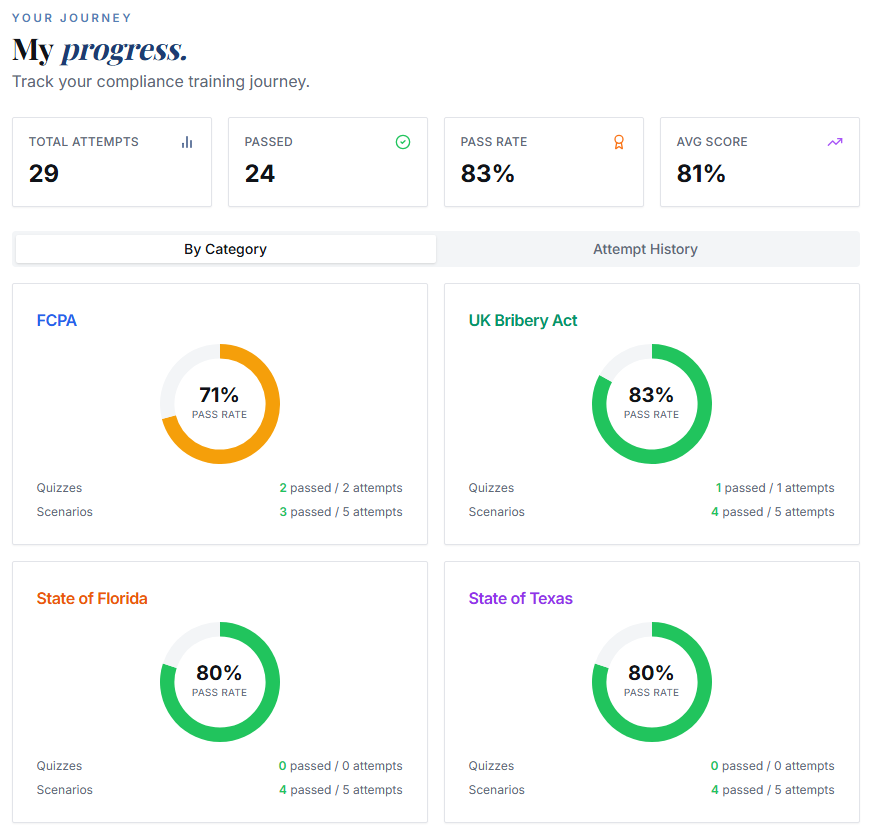
FCPA, UK Bribery Act, Florida and Texas state compliance laws, and federal-state overlap — continuously updated.
Gamified Micro-Learning
Bite-sized modules and quizzes that keep learners engaged and help knowledge stick beyond the end of the course.
The Scenario Theater
Real dilemmas.
Real consequences.
Every scenario is drawn from actual regulatory cases and ethical failures — not hypotheticals. Train your judgment on situations that mirror what your team will face.
The Golden Ticket
A city procurement officer you're bidding to work with mentions loving Astros playoff tickets. A colleague has two extras and suggests offering them "just to build the relationship."
What would you do?
Do you decline outright, report the suggestion, or ask compliance where the line actually sits?
The Facilitation Fee
A foreign distributor tells your sales lead that a small "processing fee" to a customs official is the only way to clear a shipment on time. It's described as standard practice there.
What would you do?
Do you authorize the payment, refuse and accept the delay, or escalate to compliance first?
The Padded Invoice
A subcontractor on your government contract submits hours that don't match the site logs. Reporting it could jeopardize the relationship your company depends on.
What would you do?
Do you raise it internally, report it externally, or wait for more proof?
The Family Contract
Your cousin's firm is the top-scoring bidder on a contract you helped evaluate. Nothing in the process was rigged, but you never disclosed the relationship.
What would you do?
Do you disclose it now, let the award proceed, or recuse yourself retroactively?
The Overheard Call
At a company event, you overhear two executives discussing an unannounced merger. Your personal portfolio includes significant holdings in the target company.
What would you do?
Do you freeze your trades, report what you heard, or treat it as rumor?
Who It's For
Built for anyone who
decides with consequence
Compliance Officers
Train your workforce with a grounded AI that cites the law — and surface risk blind spots before they become enforcement actions.
Client-Facing Employees
Equip sales, account, and frontline staff to handle gifts, hospitality, and conflicts of interest correctly in the moment — with answers grounded in the law.
Small & Mid-Size Businesses
Enterprise-grade compliance training and AI without the enterprise price tag. Free for individuals, affordable for teams.
Law Students & Certification Candidates
Study real enforcement cases and test your reasoning against the actual law — a genuine study tool for ethics and compliance exams.
For Teams
Now In BetaDashboard analytics, role assignments, and team oversight for organizations that need to track compliance training at scale.
Need help standing up your program first? Explore Advisory Services
Frequently Asked Questions
Questions, answered
No. ThinkEthics.ai and our AI assistant, Louis, provide educational and informational content only and do not provide legal advice. Responses may be grounded in legal, regulatory, and other authoritative sources, but laws and their application can vary based on jurisdiction and specific facts. For matters requiring legal advice or legal representation, consult a qualified attorney. ThinkEthics.ai and Louis are learning and reference tools, not substitutes for professional legal judgment.
From the Founder
Why ThinkEthics.ai exists
There are so many federal, state, and local laws in the United States that no one can definitively say how many exist.
Beyond those laws are thousands of regulations, rules, and compliance obligations governing how individuals and businesses operate. The body of law has become so vast that legal scholars, policymakers, and advocacy organizations have struggled to even quantify its full scope.
Yet we are still told that ignorance of the law is no excuse.
Think about that.
We are expected to understand and follow a body of law so vast that we cannot even reliably count the laws within it.
Over the course of my career, I worked with and alongside numerous companies doing business with cities, school districts, utilities, and other public and private entities. Far too many had little to no ethics training, and no practical framework for helping employees understand legal and compliance risk.
It wasn't because the people were unethical. In many cases, they simply didn't know where the lines were.
A salesperson was trying to build a relationship with a public official.
A project manager was invited on a trip by a vendor.
An employee was offered a gift and wasn't sure whether accepting it crossed a line.
A small business was pursuing its first government contract and suddenly found itself navigating procurement rules, conflicts of interest, gift restrictions, and compliance obligations it had never encountered before.
These are not abstract legal questions. They are decisions people make every day.
That search for answers eventually led me to GRC (Governance, Risk & Compliance). I pursued, earned, and maintained certifications in the field and continued studying the intersection of business, ethics, and legal risk. But I kept arriving at the same conclusion: law was the foundation beneath every ethics and GRC program.
Wanting to understand that foundation more deeply, I applied to and was accepted by several leading law programs before ultimately choosing the James E. Rogers College of Law at the University of Arizona.
Eighteen months later, I walked across the stage having earned a graduate degree in law, with a concentration in Compliance & Legal Risk Management.
After graduating, I began building ThinkEthics.io, the first iteration of the idea. What started as a straightforward ethics and compliance learning platform would eventually evolve into ThinkEthics.ai: a more intelligent, interactive, and engaging platform designed to help organizations and their employees learn, practice, ask, and verify.
Large organizations can afford compliance departments, legal counsel, enterprise training platforms, and dedicated risk teams. Most small and midsize organizations cannot. Individuals have even fewer resources.
The law does not become less consequential because you didn't know it existed.
That is why I built ThinkEthics.ai.
ThinkEthics.ai exists to make ethics, compliance, and legal risk education accessible to the people and organizations historically left out of the conversation. We help organizations assess their risk, build practical compliance programs, train their people, and sustain those programs over time.
Not to turn employees into lawyers. Not to replace legal counsel. But to help people recognize risk, understand the rules governing their decisions, and ask better questions before a mistake becomes a crisis.
Understanding where the lines are drawn shouldn't require a law degree or a Chief Compliance Officer.
Learn. Practice. Ask. Verify.
The Founder
ThinkEthics.ai
Get In Touch
Have a question?
Let's talk.
Whether you're exploring ThinkEthics.ai for your organization, have a technical question, or want to talk to our team, we'd love to hear from you.